
Physiological Sigh
Stanford's fastest measured stress reset. Two short inhales through the nose, one long exhale through the mouth. Drops sympathetic activation in under 60 seconds.
Coheran is built for the moment anxiety spikes: racing heart, tight chest, shallow breath, thoughts spiraling. One tap SOS launches the Physiological Sigh immediately. Add a lock screen widget so help is always one tap away. Grounding games when you need to interrupt the loop first. Heart rate biofeedback so you can see yourself calm down. Every feature is free. No ads, no subscriptions, no paywalls — our donation to everyone out there struggling.
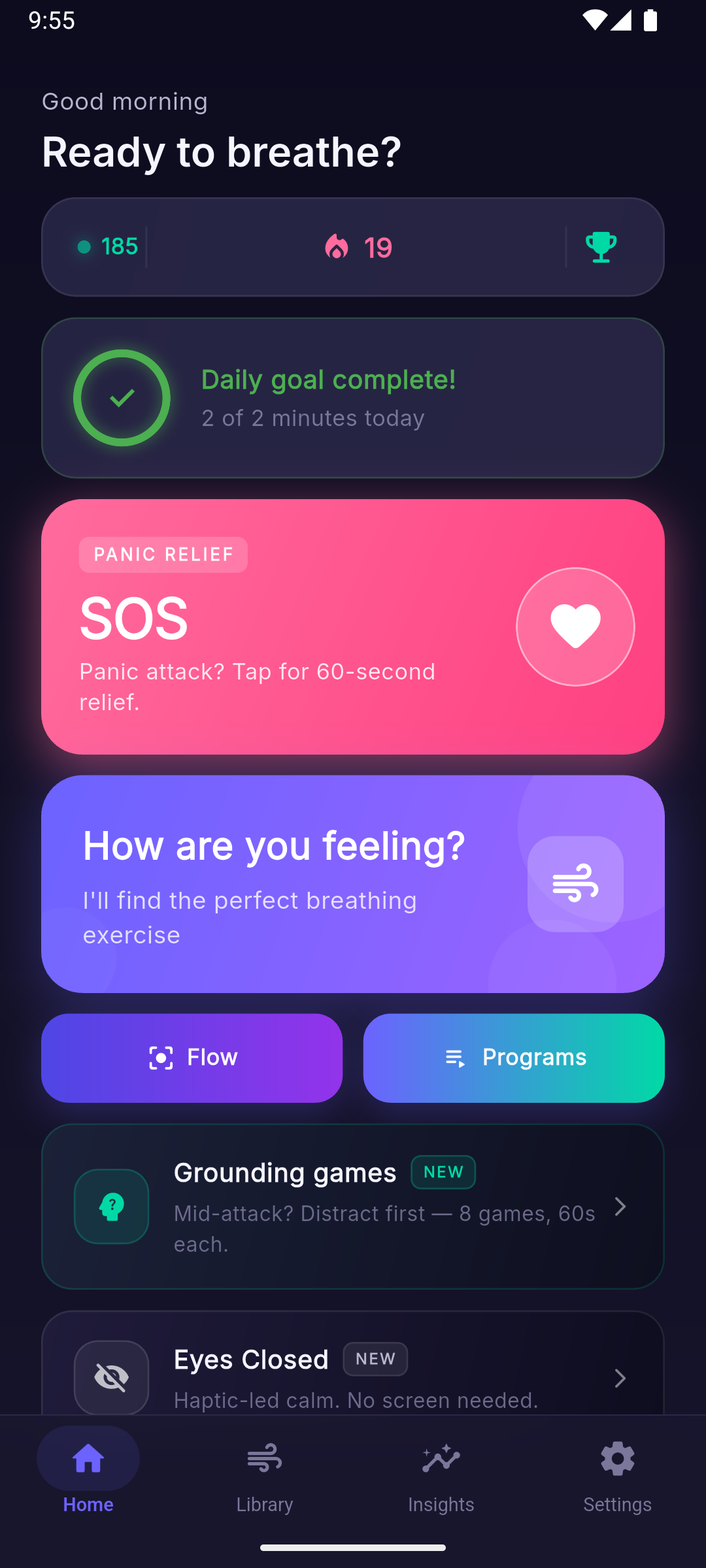
Racing heart. Tight chest. Shallow breath. The room feels wrong and your thoughts will not stop. Most wellness apps were built for calm Sunday mornings, not for this. They ask you to navigate menus, sit through introductions, and listen to a coach tell you to be kind to yourself.
Coheran was built around one question: what do you need in the next 60 seconds when anxiety hits? One tap SOS. A lock screen widget. Grounding games if breathing feels impossible yet. The Physiological Sigh when you are ready to breathe. Aftercare when the wave passes.
Every breathing technique. All 8 grounding games. Lock screen widgets, heart-rate biofeedback, unlimited Flow Mode, every guided program, every insight. There is no premium tier, no trial that runs out, and nothing sitting behind a price tag.
Panic and anxiety do not check your bank balance. The people who need this most are often the ones who can least afford another subscription — so we are giving Coheran to the world as a donation, for everyone out there struggling. If it helps you and you can spare it, there is a "Donate me a coffee" button in Settings. It unlocks nothing, because nothing is locked. If you cannot, use it anyway. That is exactly what it is for.
SOS, widgets, grounding games, breathing, and aftercare. Every feature exists to get you back to baseline as fast as possible when a panic attack or anxiety spike starts.
Right on the home screen. Launches the Physiological Sigh immediately. No mood check-in, no setup, no tutorial. Built for the airport, the elevator, the boardroom, or 3 AM when anxiety will not let you sleep.
Add Coheran to your home or lock screen so panic relief is one tap away even when you cannot think straight. SOS from the widget opens the app straight into the calming flow.
Stanford's fastest measured stress reset leads the library, alongside 4-7-8, Extended Exhale, Box Breathing, and more. Each technique opens with a 30-second "Why this works" card for your nervous system.
Place your finger on the rear camera. Coheran measures your pulse with PPG — the same principle as an Apple Watch — and shows you the exact drop after each session. Honest biofeedback, not vibes.
When the wave passes, aftercare helps you settle before you go back to your day. Prefer silence during SOS? Companion mode stays with you without asking you to do anything. Skip any step that does not feel right.
On a plane. In the subway. In a basement gym. The whole library is on‑device — your nervous system shouldn't wait for a 5G signal.
Every feature is unlocked and free — no email, no account, no analytics SDKs, nothing to subscribe to. Heart‑rate data stays on your device by default. Optional encrypted backup if you want it.
Three voice options — Calm, Warm, Bright — guide your inhale, hold and exhale. Prefer silence? Switch to haptic‑only mode and Coheran guides you with gentle vibrations.
25, 50 or 90‑minute sessions: prime your nervous system, lock in for the focus block, then decompress. Pick a soundscape (Quiet Cafe, Forest, Warm Pad), set an intent, go.
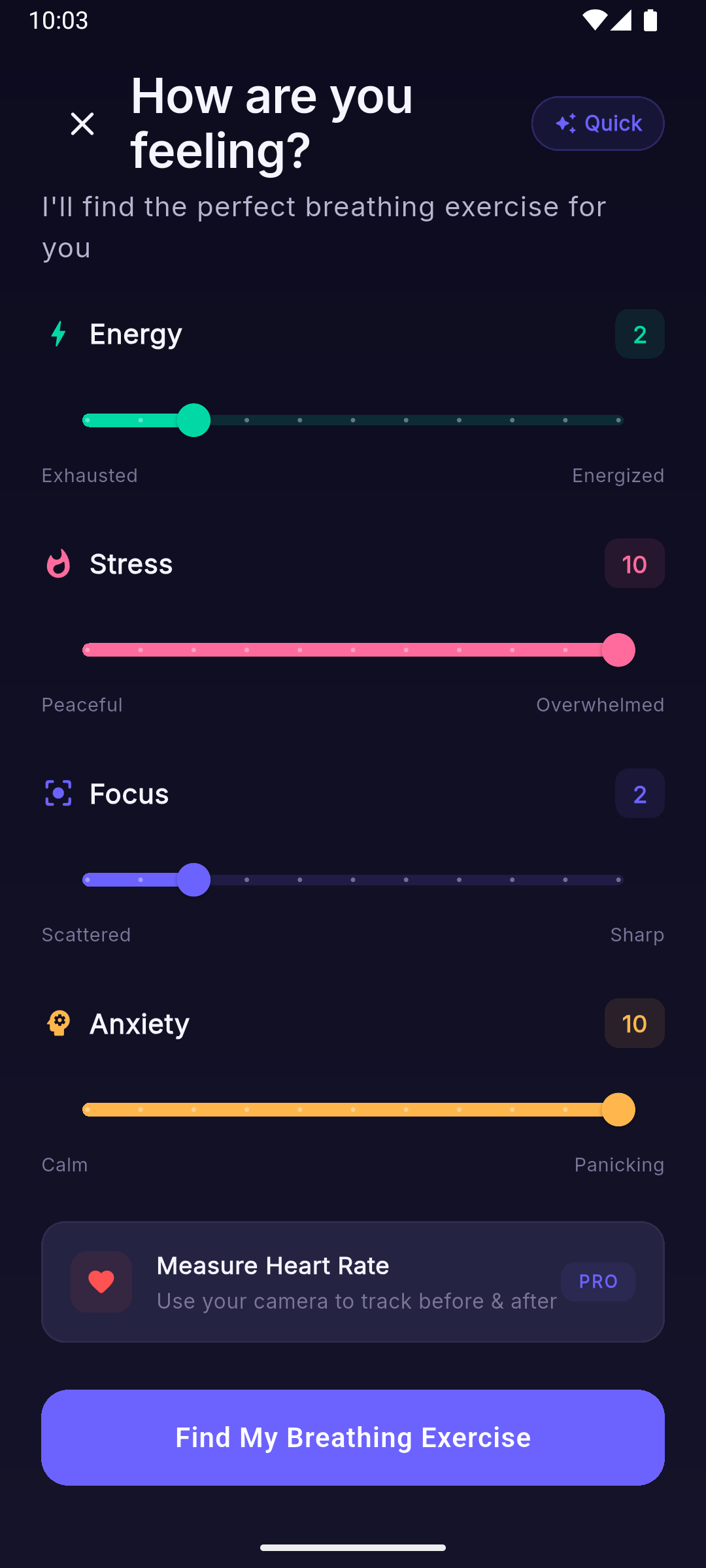
Tell Coheran how you feel — energy, stress, focus, anxiety — and it picks the perfect technique for the next 90 seconds. No quiz fatigue, no thinking required.
Build a daily habit without the guilt. Earn a streak freeze each week (capped at three) that auto‑applies when you miss a day. Habit‑forming, not punishing.
SOS panic relief when anxiety spikes. Breathing, grounding, and insights for the rest of your week.
The home screen is built for anxiety spikes. The big SOS button launches the Physiological Sigh immediately. Add a lock screen widget so help is one tap away when you cannot think straight. Quick-start chips for Calm, Energy, Focus and Sleep when you have a few more seconds.
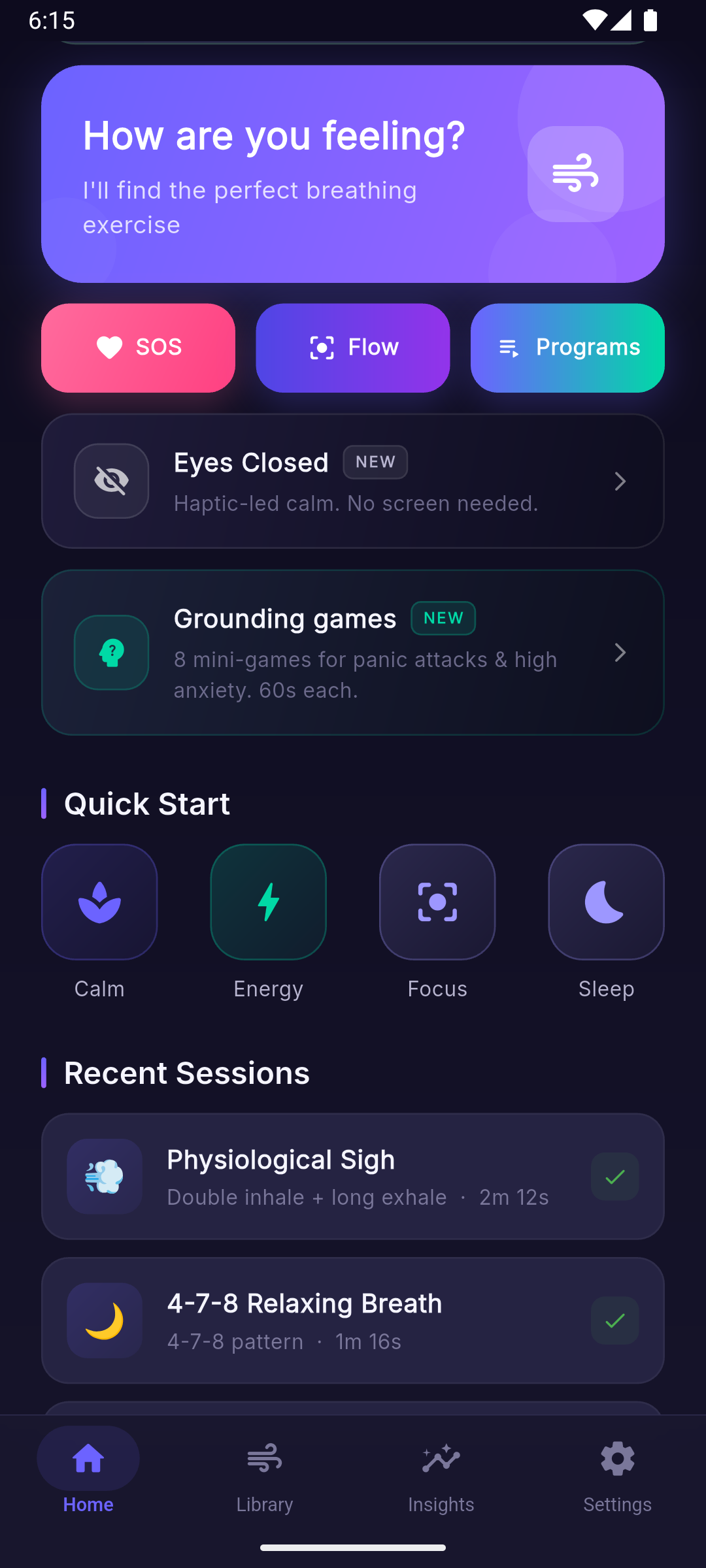
Drag four sliders — Energy, Stress, Focus, Anxiety — and Coheran's recommendation engine picks the perfect technique. Optional camera‑based heart‑rate measurement gives you a before‑and‑after comparison.
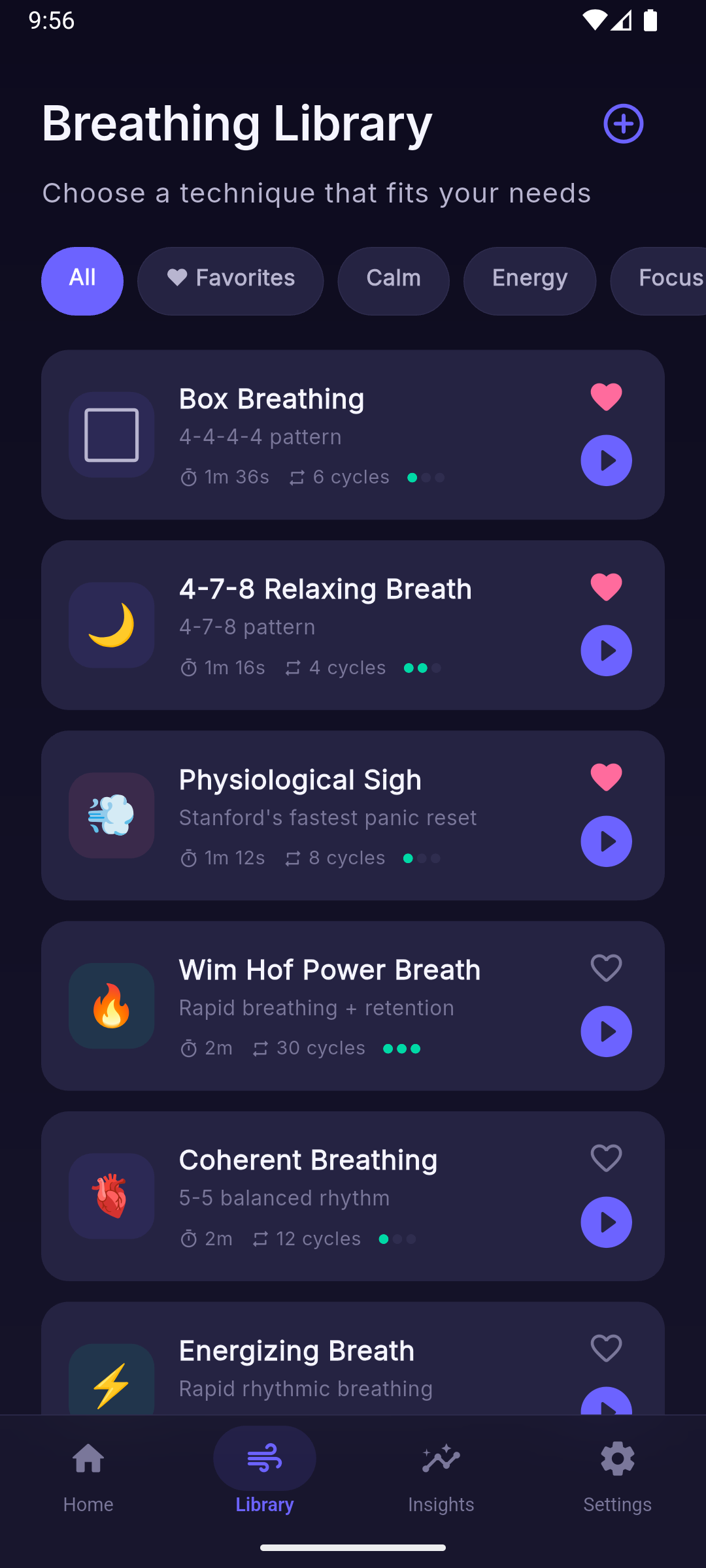
Box Breathing. 4‑7‑8. Physiological Sigh. Wim Hof. Coherent Breathing. Each technique tells you the cycle pattern, expected duration, and difficulty before you start. Favorite the ones that work for you.
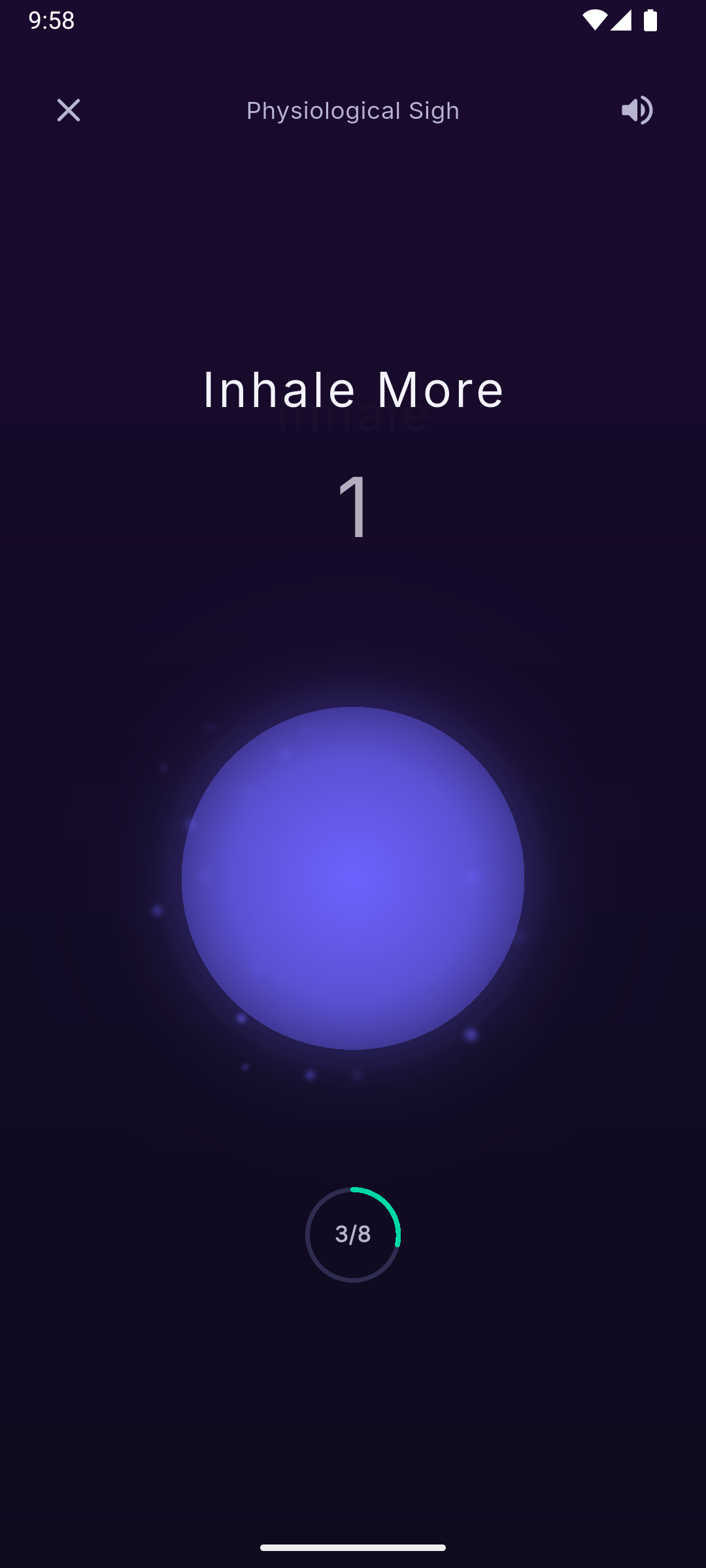
Each session opens into a single, glowing orb that expands as you inhale and softens as you exhale. No clutter. No timers screaming at you. Voice and silent haptic guidance keep the pace — you just follow the breath.
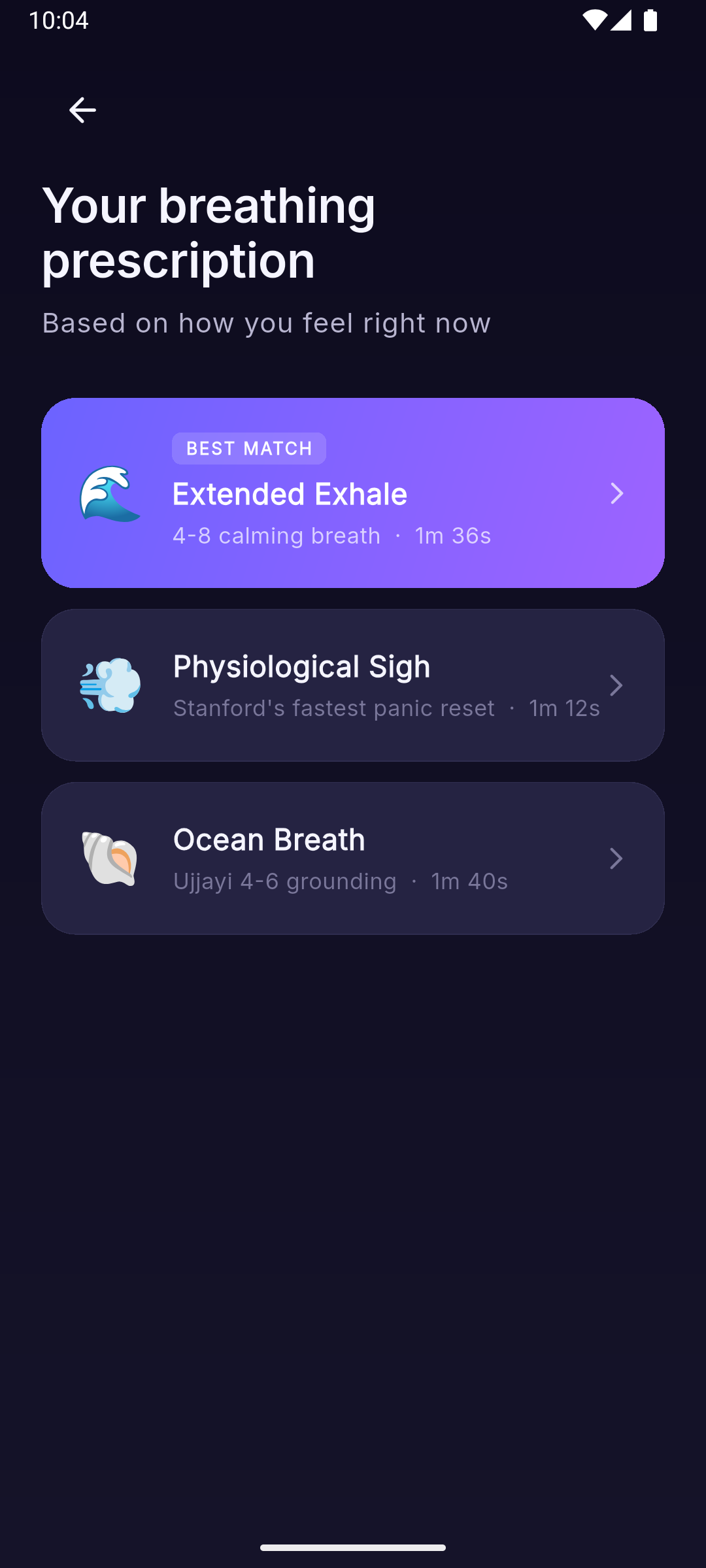
After a mood check-in, Coheran picks the exact technique for how you feel right now. High stress and anxiety? Physiological Sigh or Extended Exhale. Cannot sleep? 4-7-8 or Sleep Descent. No guessing when panic makes thinking hard.
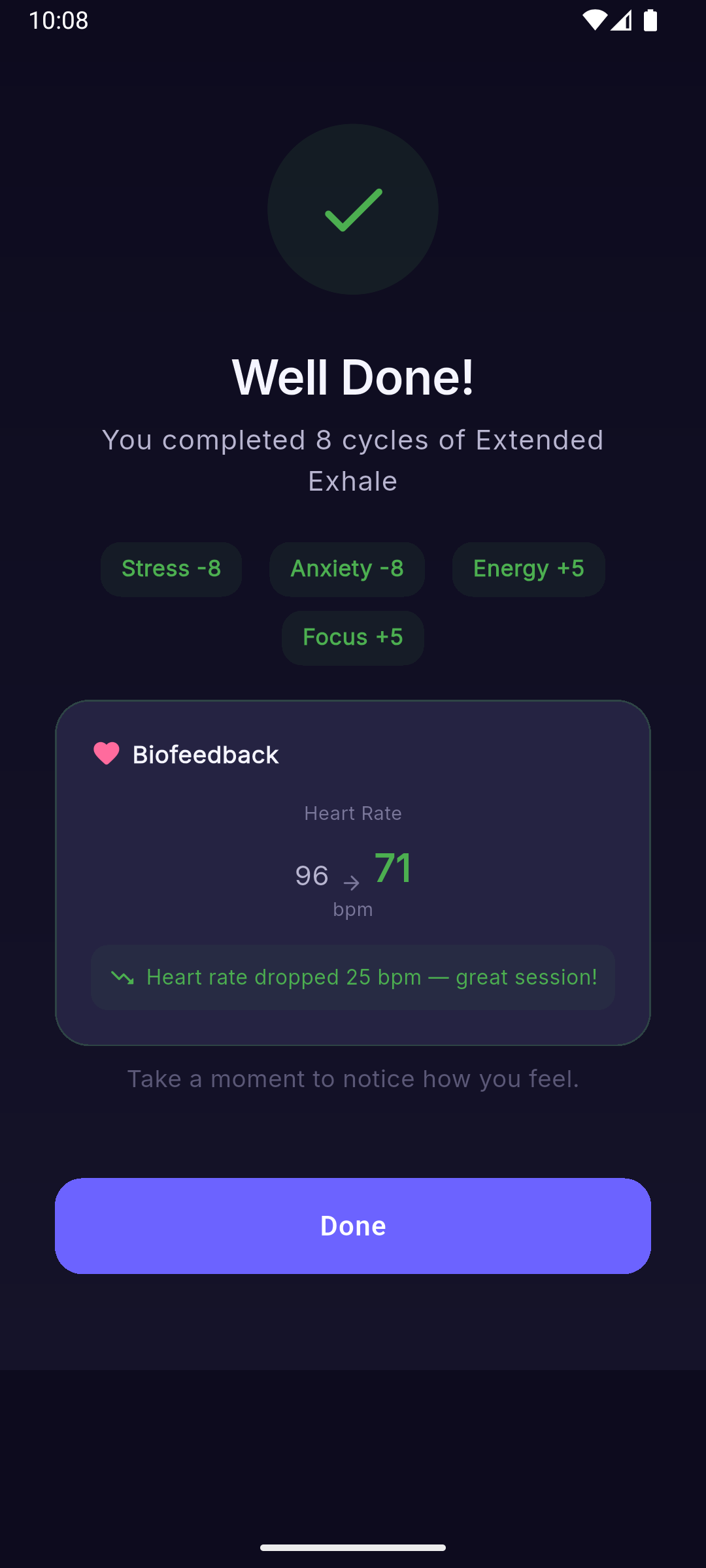
Every session ends with an honest "after" screen: how your mood metrics changed, and your real heart‑rate before vs. after. No vague green checkmarks. Just numbers.
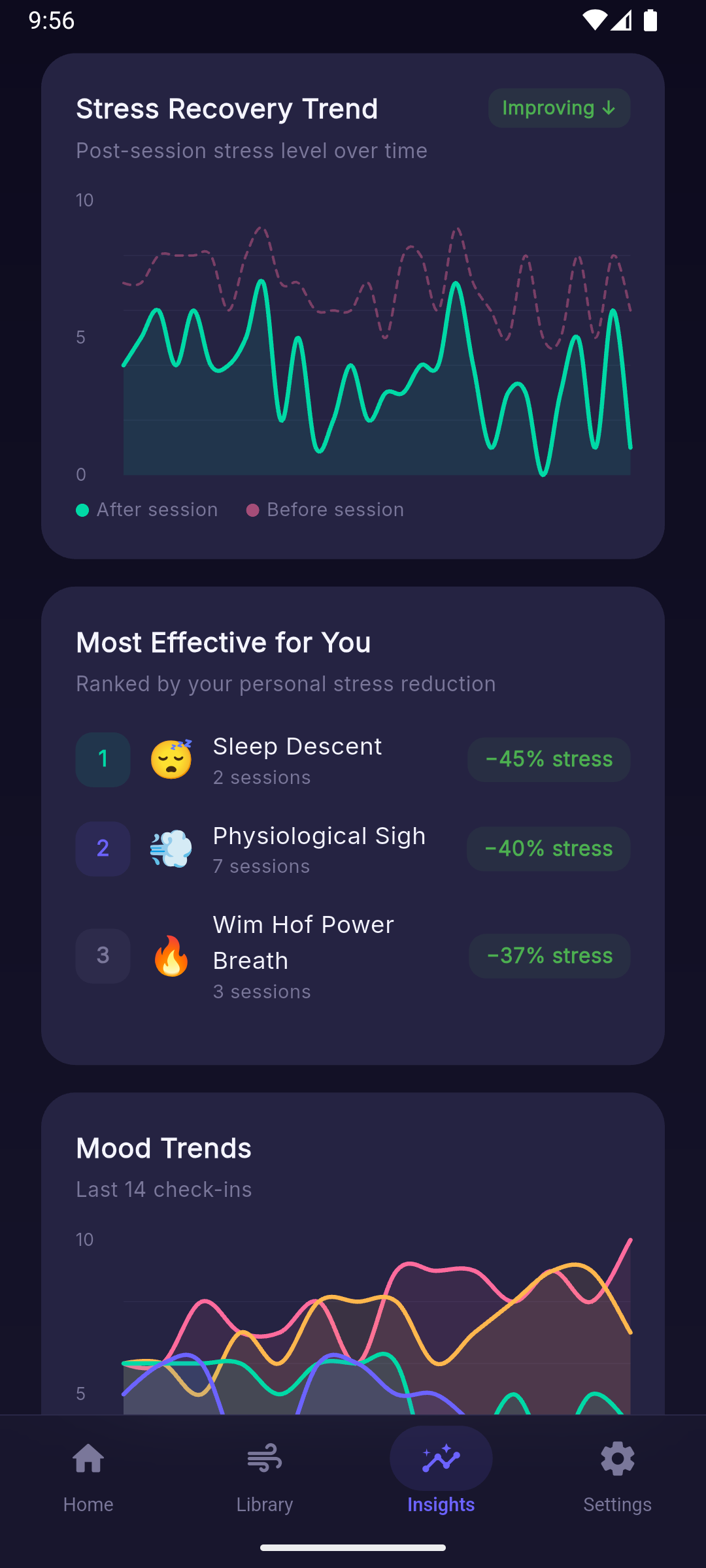
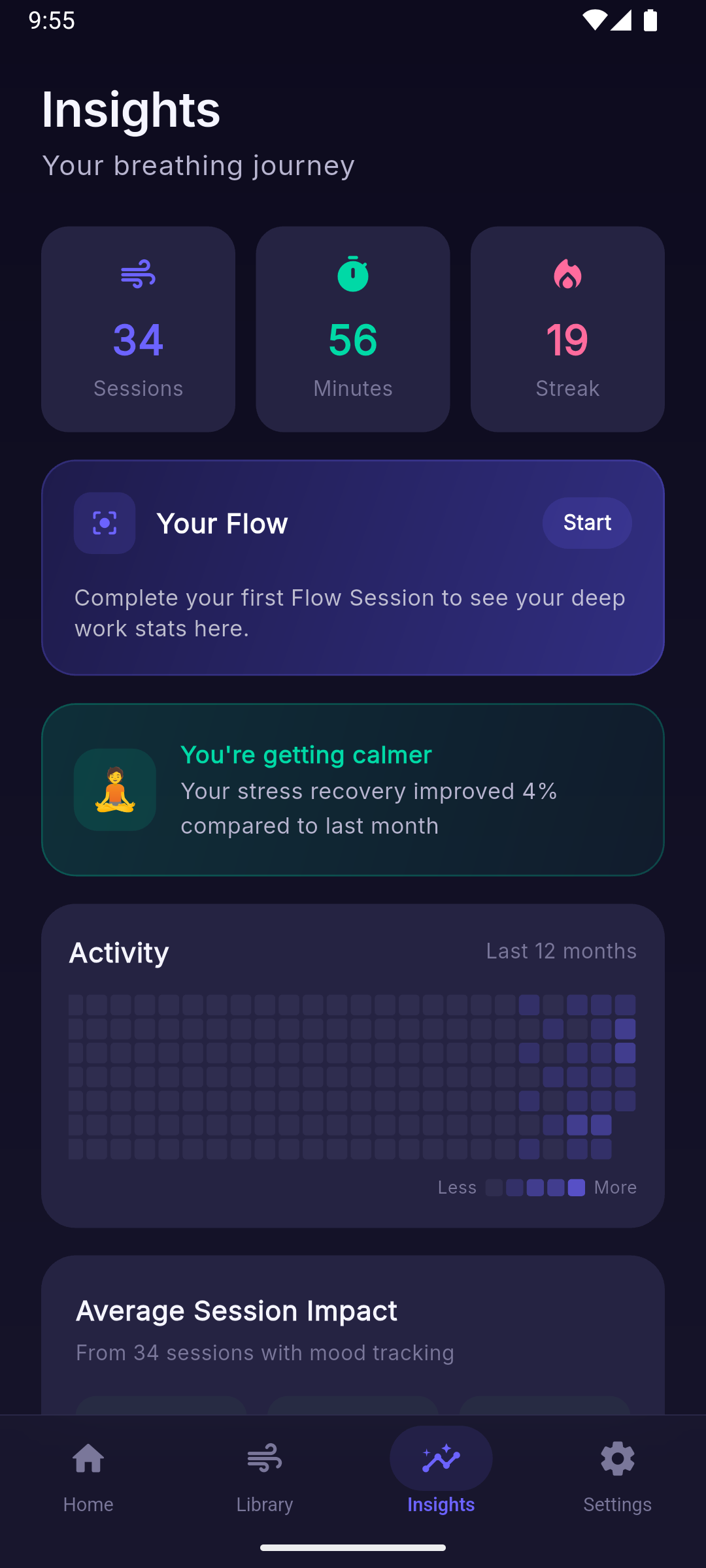
Stress recovery over time. Most effective techniques for you. Mood trends over the last 14 check‑ins. Weekly rhythm. All on your device, always — no cloud required.
A 12‑month activity calendar (the kind you've seen on GitHub, but for your nervous system). Daily streak counter. Weekly streak freezes that auto‑apply when life gets in the way. Build the habit without the shame.
One tap from panic to guided breathing. No menus, no mood quiz, no twenty-minute meditation.
Bite-sized looks at the science and the app. Tap any short to play it right here.
Tap any technique below to see what it does, what it's good for, and how long the session takes inside the app.
Stanford's fastest measured stress reset. Two short inhales through the nose, one long exhale through the mouth. Drops sympathetic activation in under 60 seconds.
Andrew Weil's "natural tranquilizer for the nervous system." Inhale 4, hold 7, exhale 8. Clinically used for falling asleep faster and pre‑flight nerves.
The exhale‑longer‑than‑inhale pattern that physically slows your heart rate. The science behind every "long sigh" you've ever felt good after.
The gentlest entry point in the app. Three‑count inhale, three‑count hold, three‑count exhale. Designed for first‑time users and kids.
The pre‑mission protocol used by Navy SEALs. Equal counts on inhale, hold, exhale, hold. The workhorse of structured calm.
Rapid breathing followed by retention. Used for energy, immunity, and cold exposure preparation. Coheran guides the cycles and the holds.
The gold standard for heart‑rate variability training. ~5 breaths per minute, equal inhale and exhale. Used in clinical HRV biofeedback for years.
Rapid rhythmic breathing to wake up the sympathetic nervous system without spiking cortisol. A short, clean energy lift in the morning.
Three‑sided pattern — inhale, hold, exhale — that primes attention. Pair with Flow Mode for the cleanest start to a focus block.
The traditional yogic technique for nervous‑system balance. Coheran's voice guides which nostril to close, on the beat.
The slow, audible "ocean" breath used in yoga and pranayama. A grounding rhythm with a calming sound that doubles as a focus anchor.
A slow, descending‑pace ramp into deep relaxation — designed to be the last thing you do before lights out. Pairs with the silent haptic mode.
Breathing calms the body. Grounding games reclaim the mind. When the panic loop is too loud to breathe through, a precise, demanding micro-task is the fastest circuit-breaker neuroscience has documented — and it works whether the spiral has already started or you can feel one coming on.
A panic attack is your amygdala — the brain's smoke alarm — firing as if you're being hunted. Cortisol and adrenaline flood the bloodstream. Blood drains from the prefrontal cortex (the rational brain) and pools in your limbs for fight or flight. There's no tiger in the room, and you can't out-reason a brain that has gone offline. That isn't weakness — it's a 200,000-year-old survival circuit doing exactly what it evolved to do.
The prefrontal cortex and the amygdala fire in mutual inhibition — when one comes online, the other quiets. Grounding games are top-down regulation made physical: a precise, time-locked motor task the amygdala can't process and the prefrontal cortex must engage to complete. You're not distracting yourself from panic. You're physically wrestling control back from your fight-or-flight system, one tap at a time.
The panic waveform typically peaks at 90–120 seconds, then collapses on its own. Most apps ask you to ride it out. Coheran's grounding games shorten the climb. Sixty seconds of demanding attention is the documented minimum dose to re-engage the prefrontal cortex and pull the brain out of the limbic loop — and one physiological sigh on top of that compounds two of the fastest nervous-system regulators in the research.
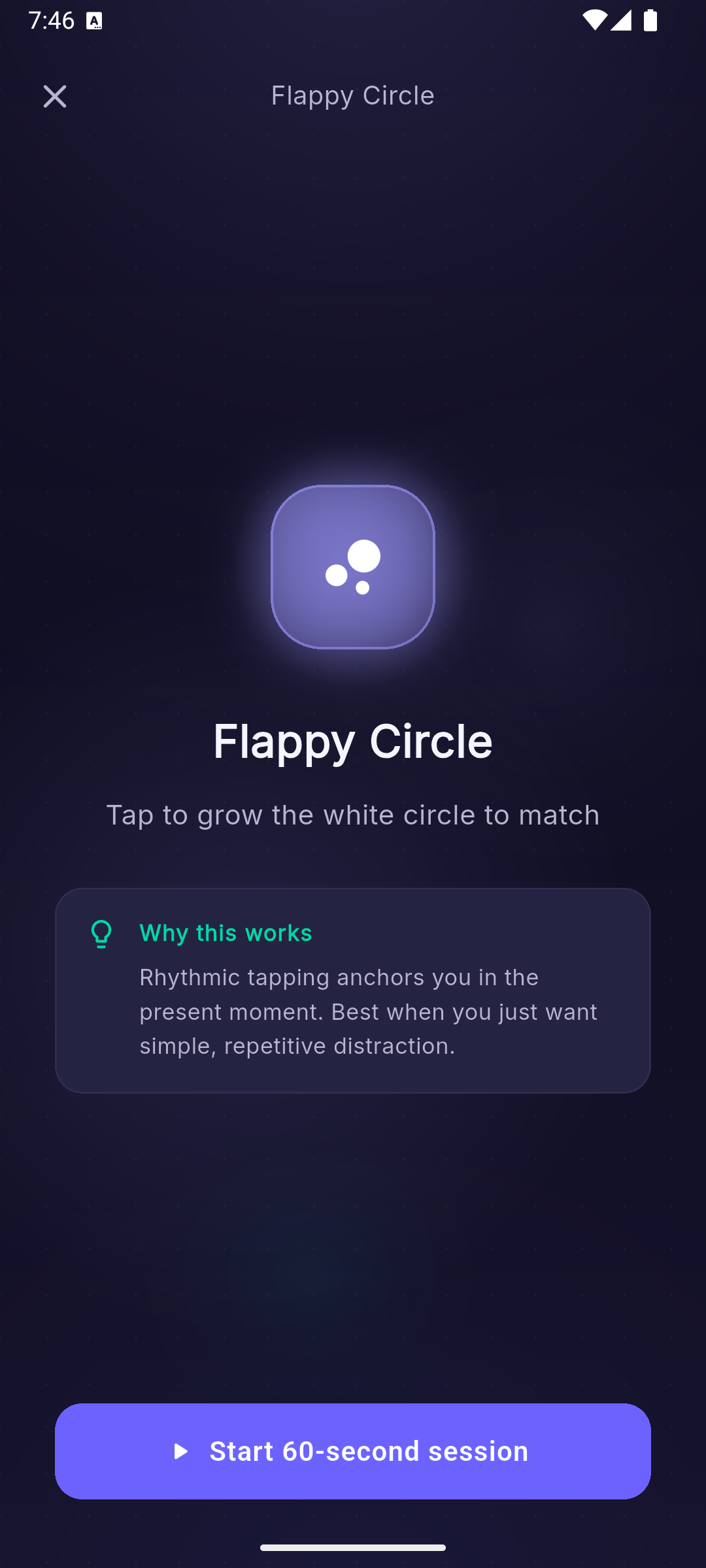
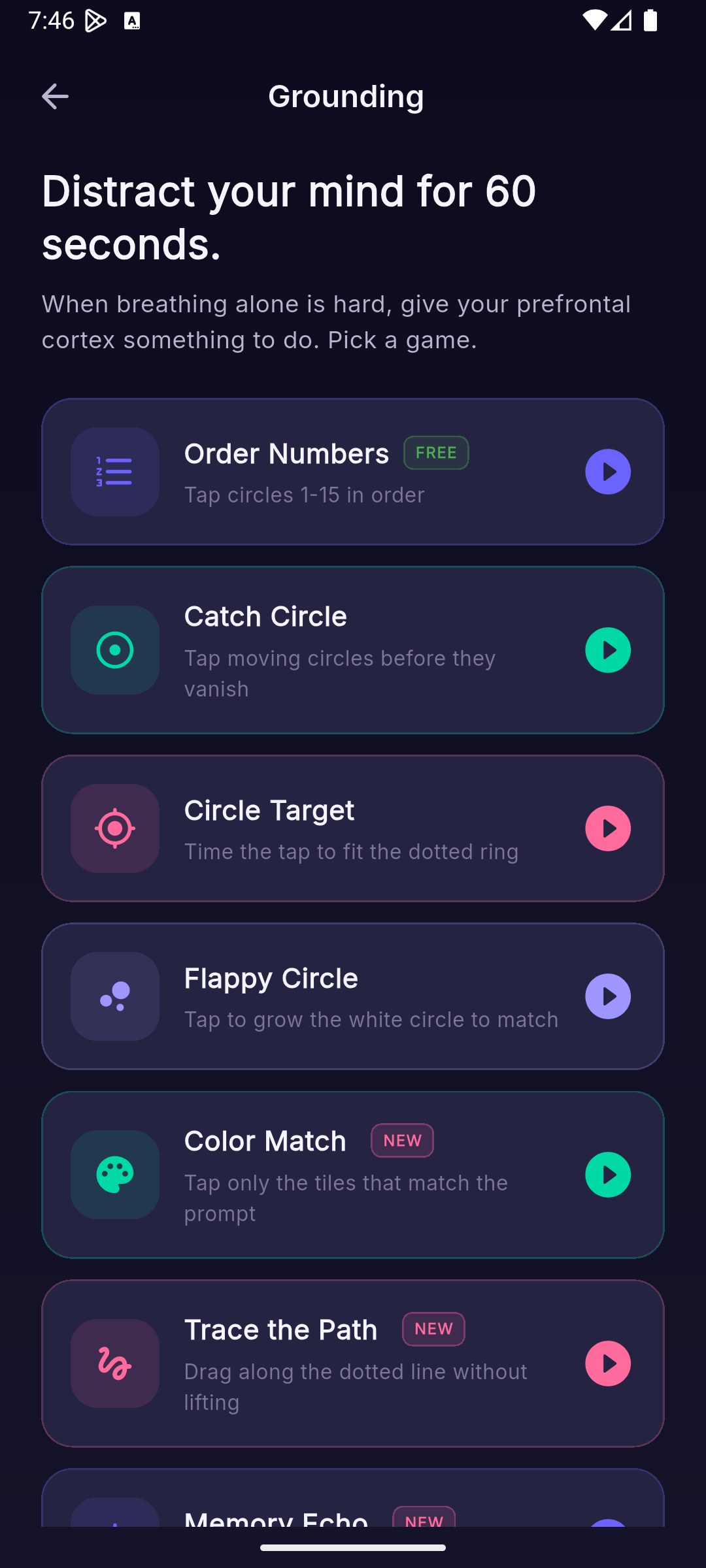
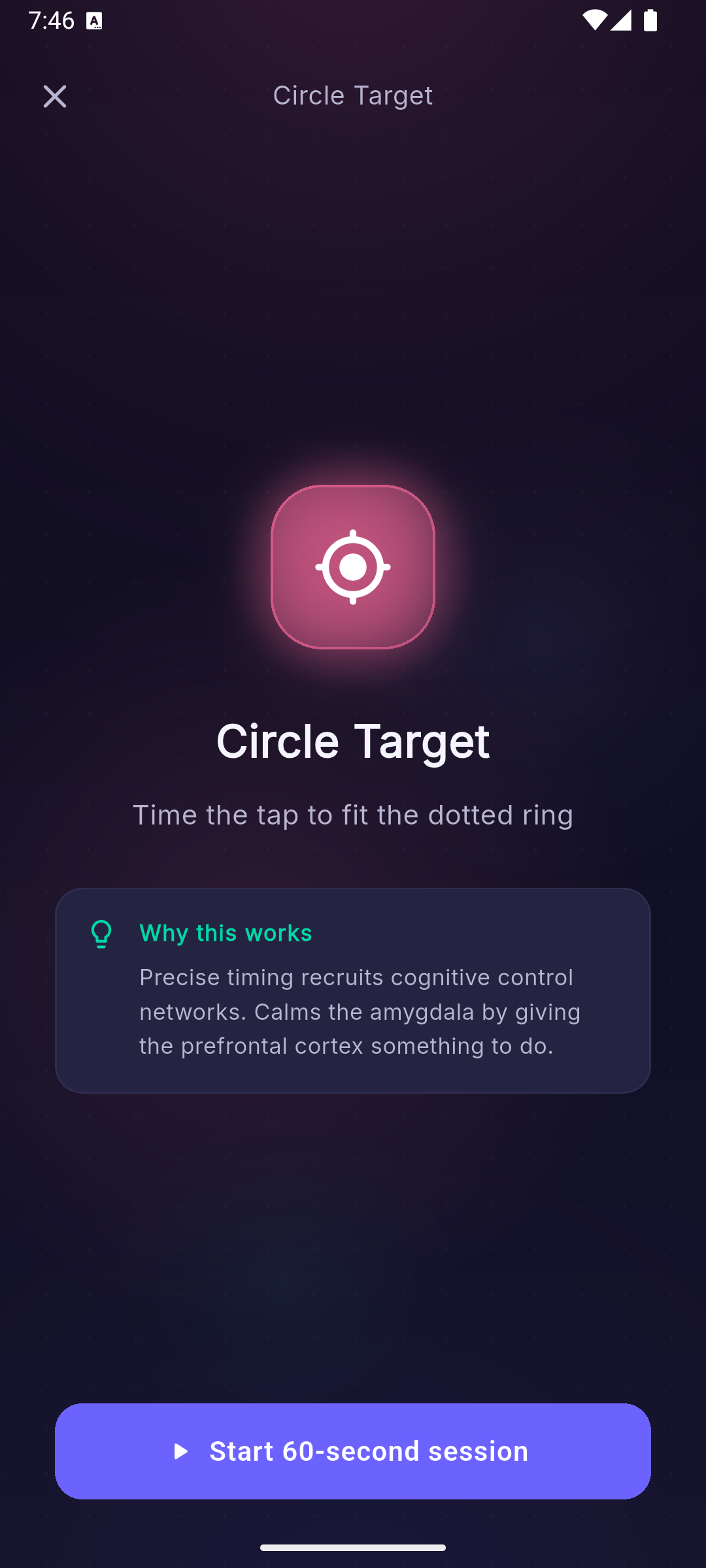
Most apps try to calm a panic attack by adding more — more prompts, more choices, more screens. Coheran's grounding games do the opposite: one mechanic, one goal, sixty seconds. Simple enough to start mid-panic, demanding enough to displace the spiral.
Each game targets a different cognitive lever — working memory, motor timing, inhibitory control, sustained tactile attention, visual search, rhythmic entrainment. Eight games, eight different ways to switch your nervous system back on. And each one ships with a "Why this works" science card that names the exact neural mechanism — because understanding what's happening to your brain is itself grounding.
What you'll feel: within 30 to 60 seconds, the internal narration starts to quiet. Heart-rate slows. The room feels like the room again. Not because the game is magic — because your nervous system is.
Tap rhythmically to grow a circle to match the target size
Rhythmic tapping at your own pace triggers cortical entrainment — your brain's electrical activity literally synchronises to the rhythm of your finger. Within 30 seconds, anxious beta-wave activity drops and calm alpha-wave activity rises. The simplest mechanic in the library, and the one most users reach for the instant they feel a spiral starting.
Time your tap to land exactly on the dotted ring
Precision timing forces the cerebellum, basal ganglia, and prefrontal cortex to cooperate on one well-defined problem. Narrow-aperture motor tasks starve the panic centre of bandwidth — the same effect archery and target shooting use to drop a competitor's heart-rate in seconds. Hit the ring, miss the ring, hit it again. You're not playing a game — you're rebooting your nervous system.
Tap moving circles before they vanish from the screen
Visual tracking activates the dorsal attention network — the same pathway elite athletes use to find calm under pressure. As long as a target is moving on screen, your brain physically cannot also model the panic story in your head. By design, your future-tense fear loop has nowhere to run.
Tap the circles 1 through 15 in sequence, against the clock
Sequential numerical ordering is the digital cousin of the 5-4-3-2-1 grounding technique therapists teach for panic attacks. It loads working memory and visuospatial scanning at the same time — two of the cognitive systems an active panic attack steals from. Each correctly ordered tap is a tiny vote against catastrophe.
Tap only the tiles that match the on-screen prompt — ignore the rest
Selective attention with go/no-go decisions is the canonical inhibitory-control task — the exact paradigm clinical researchers use to measure prefrontal-cortex function. Picking the targets while ignoring the distractors physically retrains the brain's brake system. It's why CBT therapists quietly love this kind of exercise.
Drag your finger along a dotted line — without lifting once
Sustained tactile attention activates the somatosensory cortex — the part of the brain that processes "where am I in space, right now." Continuous proprioceptive input is among the fastest documented routes out of a dissociative or panic spiral. Your fingertip becomes a portable nervous-system reset button.
Watch a growing sequence of patterns, then repeat it back
Working memory has a hard ceiling — roughly 4 ± 1 items at a time. When the ruminative loop is using it, you panic. When a Memory Echo sequence is using it, the loop physically cannot run. Each new round drags you forward in time, away from the trap.
Find the one shape that's slightly different from the rest
Visual search recruits here-and-now attention from the parietal cortex. Scanning a grid for the one outlier sharpens focus and crowds catastrophising thoughts out of awareness. Closest digital relative of the classic "look around the room and name what you see" therapy technique.
Multi-day programs that train your nervous system so the next anxiety wave hits softer. The 10-Day Anxiety Relief program is the fastest path from first download to a personal panic toolkit.
Build a daily breathing habit with gentle techniques. From 3‑3‑3 to Coherent Breathing. The on‑ramp.
Two weeks of relaxation breathing — Extended Exhale, Ujjayi, 4‑7‑8 — leading to a full Sleep Descent practice.
From grounding basics to the Physiological Sigh. By day 10 you have a personal toolkit for the next panic attack or anxiety spike.
Use breathing to prime focus. Coherent Breathing, Box, Triangle Focus. Pairs with Flow Mode.
You shouldn't have to trade your nervous‑system data for a calmer one. Coheran is built so the most private moments of your day stay private.
We didn't paywall the panic button — and now we've removed every other lock too. One version, everything unlocked, free for everyone.
$0 no signup, no card, no ads
Your call only if you can spare it
If you are struggling right now, please keep your money. Coheran is our donation to you. Come back and buy the coffee some year when things are easier — or never. Both are fine.
Yes — completely, and every feature is included. The one‑tap SOS panic button, all 12 breathing techniques, all 8 grounding games, lock screen widgets, heart‑rate biofeedback via the phone camera, unlimited Flow Mode at every duration and soundscape, all multi‑day guided programs, custom techniques and advanced insights. No subscription, no trial, no lifetime purchase, no paywalls, and no ads of any kind. Nothing is held back.
There is no catch. Panic and anxiety don't check your bank balance, and the people who need help most are often the ones who can least afford another subscription. So we're giving Coheran to the world as a donation — for everyone out there struggling. We don't run ads, we don't sell your data, and we have no investors to repay. If the app helps you and you can spare it, there's an optional "Donate me a coffee" button in Settings. It unlocks nothing. If you can't, use the app anyway — that's exactly what it's for.
Yes. The whole library is on‑device. Use it on a plane, in the subway, in a basement gym, or anywhere with no signal.
No. No signup, no email, no tracking SDKs. Open the app and start breathing in seconds.
Place your finger on the rear camera. Coheran uses PPG (photoplethysmography) — the same principle as an Apple Watch or Fitbit — to measure your heart rate before and after each session. No extra hardware required.
Yes. Coheran is built for the moment a panic attack or anxiety spike starts. One tap SOS launches the Physiological Sigh immediately. Add a lock screen widget for instant access when you cannot navigate menus. If breathing feels impossible yet, start with a 60-second grounding game to interrupt the spiral. Aftercare and silent companion mode help you settle when the wave passes. Skip any step that does not feel right.
No. Coheran is a tool for nervous‑system regulation in the moment. It is not medical advice and is not a substitute for professional mental‑health care. If you're in crisis, please contact a licensed clinician or your local emergency services.
Yes — Coheran is now on the App Store for iPhone and iPad, and on Google Play for Android. Everything is free on both platforms — same one‑tap SOS, same 12 techniques, same 8 grounding games.
Coheran is built by CANVERSI S.R.L., a small independent studio based in Oradea, Romania. We don't take VC money, we don't sell data, we don't run ads, and we answer support emails personally. We give the app away because we think help during a panic attack shouldn't have a price tag.
One tap SOS. Lock screen widgets. Grounding games. The Physiological Sigh. Every feature free, no ads, no subscription, works offline, no signup. On iPhone and Android — our donation to anyone who needs it.
100% free · No ads · No subscriptions · No signup · Works offline